
ANONYMIZED CASE STUDY ·
AGRICULTURE EXPO DEMAND GENERATION
362% Pre-Registration Growth for an Agriculture Trade Expo
I rebuilt the website as the campaign hub and connected every channel into one tracked funnel. The same budget worked harder: registrations grew 4.6x and exhibitor demand went from near zero to 103 qualified inquiries.
CAMPAIGN RESULTS
// SOURCED
11,537
Pre-registrations
// registration system
103
Qualified exhibitor inquiries
// CRM
41NT$
Cost per registration
// Google Ads + registration data
27%
Registration conversion
// GA4 + registration completions
CLIENT
Anonymized international agriculture & agri-tech trade exhibition (Taiwan-based)
INDUSTRY
Trade exhibitions / agriculture & agri-tech events
MARKETS
Taiwan, plus overseas exhibitors and buyers across Asia (EN + TC)
SERVICES
Website rebuild, conversion tracking, paid media, remarketing
TOOLS
GA4, GTM, Meta Ads, LinkedIn Campaign Manager, Google Ads, LINE, CRM
TIMELINE
One event campaign cycle
THE STARTING POINT
The site leaked the demand it had
The client runs a major agriculture and agri-tech exhibition with two revenue lines. The first is visitor attendance: farmers, distributors, food and livestock producers, aquaculture operators, and agri-tech buyers. The other, higher-value line is exhibitor participation: equipment makers, feed companies, farming-technology brands, and overseas suppliers seeking exposure across Asia.
The starting point was not zero marketing. It was worse: activity with no connected system. The website and paid channels sat with separate agencies, and the site was dated, not built around the two actions that mattered: visitor registration and exhibitor inquiry. Tracking was weak, so audiences barely formed and spend could not be read cleanly.
The event already had brand awareness, so people searched the name or arrived from referrals, landing somewhere that did not guide them. The real issue was not low traffic. Existing demand arrived at a weak destination, and the system let it leak.
THE CHALLENGE
Why more traffic would not have helped
This was an event campaign with a fixed deadline, two buyer journeys with different economics, and ownership split across separate agencies that never shared data.
A weak destination
The website behaved like a brochure. It showed information but did not convert. Visitors had to dig for registration, and exhibitors found no clear proof of audience quality or an easy path to inquire.
Every channel a silo
Separate agencies ran separate channels with no shared data. Meta optimized for cheap clicks, Google for traffic, each for its own surface metric. Nobody owned the full path from audience to conversion.
Two journeys, one deadline
Registrations are volume. Exhibitor inquiries are value. One site had to serve both economics without confusing the user. And an event window is perishable: fix the funnel too late and the chance is gone.
THE GOAL
Grow registrations and create real exhibitor demand
Primary KPI: pre-registrations and qualified exhibitor inquiries through one tracked funnel
Target: 8% pre-registration growth, plus meaningful exhibitor demand from near zero
Success: registrations and exhibitor SQLs the sales team can act on, measured cleanly
FULL-SYSTEM MARKETING
The website became the hub every channel fed
The new site was built conversion-first, so every channel had one destination and one job. Meta and LINE drove visitor volume. LinkedIn and Google Search drove higher-intent exhibitor demand. The system was action-first, not channel-first.
VOLUME → Meta / LINE → conversion-first site → registration CTA → GA4 + pixel tracking → 11,537 pre-registrations
VALUE → LinkedIn / Search → exhibitor path → inquiry form → CRM qualification → 103 exhibitor SQLs
Paid media created the reach. The website created the result.
EXECUTION
I rebuilt the campaign from the destination back
01
Rebuild the site for two separate journeys
The first decision was to stop asking the website to explain everything and start asking it to convert two actions. The old site was organized like most event sites: about, news, venue, agenda, contact. Useful for browsing, useless for converting.
So I rebuilt the information architecture around business actions, not information hierarchy. The homepage positioned the show fast. One path made visitor registration the obvious primary action. A separate path showed exhibitors the audience opportunity and led to a booth inquiry. Conference and product content gave visitors more reasons to attend. Hotel, venue, and travel pages cut friction for overseas and non-local buyers. CTAs repeated across pages by intent. The non-obvious pivot was reframing the site from event website to campaign hub: the center every channel would feed, not a brochure people read once.
Why this matters: two audiences with different goals cannot share one generic page. Splitting the journeys made the site easier to use and gave every downstream channel a clear action to drive toward.
02
Measurement had to come before media
Event deadlines create pressure to launch media immediately. I did the opposite and fixed the measurement layer first. Buying traffic into a black box would only scale the leakage already in the funnel.
Before raising spend, I connected the site and the channels so each click could teach the next decision. I installed and verified the platform pixels, configured GA4 and GTM conversion events, and tracked registration clicks, registration completions, and exhibitor inquiry submissions as distinct actions. UTMs were standardized across Meta, LinkedIn, LINE, and Google so every source read cleanly. Remarketing audiences were built from page visits and form-intent behavior. That turned the website from a one-way destination into a feedback loop the campaign could optimize against.
tracked conversion events
primary · registration completion + exhibitor inquiry submission
secondary · registration click + exhibitor-page visit
audiences · page visitors + form-intent behavior → remarketing pools
GA4 + GTM · UTMs consistent across Meta, LinkedIn, LINE, Google
03
Give each channel a job it could win
A single message across every channel would have flattened the campaign. Visitor and exhibitor motivations are too different. A visitor responds to event value, convenience, and industry relevance. An exhibitor needs commercial proof, audience quality, and a clear booth opportunity. Treating all channels the same would have wasted both.
So I stopped asking every channel to do the same job and matched each to the work it could realistically win. Meta carried broad reach, visitor registration, and remarketing. LinkedIn reached exhibitor decision-makers with booth-inquiry messaging. Google Search captured people already looking with event, agriculture, supplier, and solution intent. LINE added a localized push for Taiwan and Asia. The point was never to make every channel look equal. It was to make every channel useful.
channel role · approximate share
Meta · volume + remarketing · ~80% registrations · ~60% exhibitor leads
LinkedIn · exhibitor demand · ~20% exhibitor SQLs
Google Search · high-intent capture · ~20% exhibitor SQLs
LINE · localized registration · ~10% registrations
approximate shares · multi-touch journeys overlap, not a clean sum
04
Let the page convert what the ads brought
Paid traffic creates reach quickly, but it cannot fix a weak destination. The obvious move would have been to keep tuning the ads. The better lever was the page experience after the click.
So I improved what happened once the visitor arrived. Above-the-fold CTAs were clear. The visit and exhibit paths stayed separate so neither audience got lost. Event credibility signals were stronger. The path to a form submission got shorter, and CTAs repeated after key proof sections. The experience was mobile-first, and practical information like venue, hotel, and travel was easy to reach. Once the page matched the intent of the traffic, spend stopped leaking. The conversion-first site turned visitors into registrations at a 27% rate. The ads did not win alone. The site carried the conversion.
05
Optimize two outcomes with different economics
The campaign could not run on one blended KPI. Pre-registration volume and exhibitor SQLs have different audiences, values, and costs. Cheap registrations alone would not prove business impact. Exhibitor demand mattered because it fed event revenue and the sales pipeline.
So I moved from campaign performance to business-outcome performance. Visitor campaigns optimized toward a lower cost per registration. Exhibitor campaigns optimized toward qualified inquiries, not raw form fills. Budget allocation weighed both volume and commercial value, and reporting kept the two costs separate. This distinction is the whole point: NT$41 per registration and NT$2,220 per exhibitor SQL are not the same economic action, and treating them as one would have hidden where the real value came from.
two economic actions, measured separately
registration · NT$41 cost per registration · volume goal
exhibitor SQL · NT$2,220 cost per qualified inquiry · value goal
reported separately, never blended into one cost
Both KPIs improved. Pre-registrations reached 11,537 against an 8% growth target. Exhibitor inquiries grew from near zero to 103 qualified, split 68 domestic and 35 overseas.
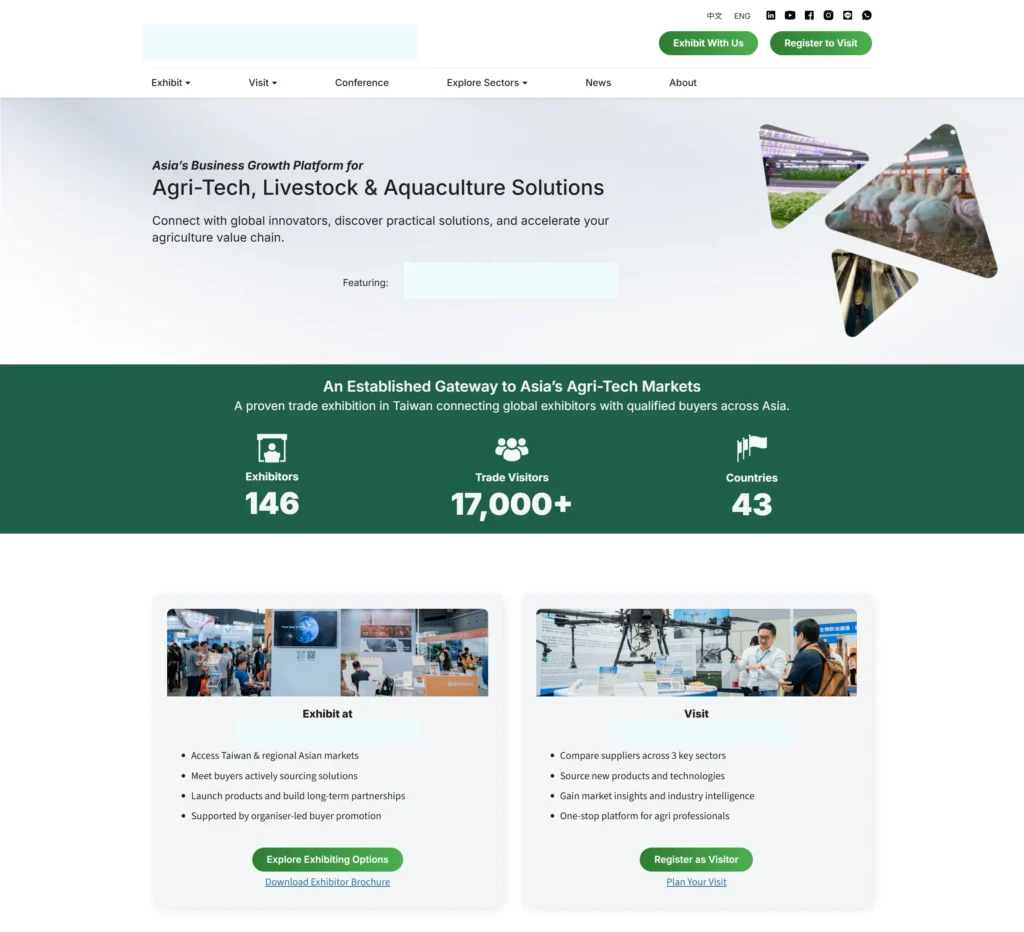
The rebuilt website turned a fragmented event campaign into one conversion-first hub, guiding visitors toward registration and exhibitors toward qualified inquiries through a tracked, multi-channel funnel.
THE MOMENT IT BECAME REAL
The shift showed up as exhibitor inquiries, not ad clicks.
The campaign started to feel real when exhibitor inquiries began arriving through the new website, from domestic and overseas prospects alike. These were not visitors clicking an ad on impulse. They were companies raising a hand to discuss taking a booth.
One overseas inquiry showed the system working end to end. The prospect did not arrive and convert in a single visit. They came in through campaign traffic, found the exhibitor information path, and explored the audience opportunity the show could offer a supplier weighing exposure in Taiwan and the wider Asian market. The interest was real, but the decision was not immediate.
They left without inquiring. That is where most campaigns quietly lose the prospect. Here, the tracked funnel and remarketing brought them back later. On the return visit they reached the exhibitor path again, read the case for participating, weighed the audience quality, and submitted a booth inquiry the sales team could act on directly.
That return was the proof. Paid media had created the reach. The website had carried the business case. Tracking had made the handoff visible, so a warm prospect was recovered instead of lost. The campaign was producing real commercial demand, not just traffic and form fills.
Marketing stopped promoting the show and started producing the exhibitor demand the sales team could act on. That was the moment the system proved itself.
RESULTS
Connected channels did what more spend could not
The site no longer depended on any single channel to perform alone. Every source landed in the same tracked, conversion-first system. Headline: pre-registrations grew 4.6x to 11,537, against an 8% growth target.
OUTCOME
RESULT
SOURCE
Pre-registrations (from 2,497)
11,537
registration system
Pre-registration growth (target: 8%)
362%
calculated from registration data
Qualified exhibitor inquiries
103
CRM
Domestic / overseas exhibitor SQLs
68 / 35
CRM
Registration journey conversion
27%
GA4 + registration completions
Cost per registration (from NT$147)
NT$41
Google Ads + registration data
Cost per exhibitor SQL
NT$2,220
ad platform + CRM
Managed ad spend (all channels)
NT$723K
ad platform invoices
Channel contribution — shares are approximate and overlap on multi-touch journeys, so they describe contribution, not a sum. Google Search captured high-intent demand and LINE pushed localized registration; both fed the same funnel.
VOLUME ENGINE
Meta
[NT$487K managed · from spend export]
~80% of pre-registrations
~60% of exhibitor leads
broad prospecting + remarketing
~9,230 implied registrations
EXHIBITOR-DEMAND CHANNEL
[NT$194K managed · from spend export]
~20% of qualified exhibitor SQLs
decision-maker targeting
booth-inquiry creative
~20 to 21 implied exhibitor inquiries
The headline was registration volume, but the business value sat in the exhibitor demand underneath it. The same budget worked harder once the website became the hub: 11,537 registrations and 103 qualified inquiries from one tracked funnel. Across roughly NT$723K in managed spend, the directly attributed registration and exhibitor campaigns drove those two outcomes, with registration cost at NT$41 and exhibitor SQL cost at NT$2,220. The lesson was not that one channel won. Connected channels beat more spend.
WHAT'S NEXT
Turn one event cycle into a year-round engine
The next phase keeps the system running between events, instead of restarting from zero at each campaign window.
- Build a year-round demand engine: keep the website active and build audiences before the next window.
- Expand SEO carefully using Search Console data around agri-tech, livestock, aquaculture, and exhibition intent.
- Separate exhibitor acquisition from visitor promotion, with dedicated overseas exhibitor campaigns starting earlier.
- Improve the CRM handoff: track each inquiry from raw to qualified to booth confirmed.
- Build remarketing audiences months before the event, not only in the final push.
Want this kind of system for your next campaign?
I build the website, channels, and tracking as one connected funnel, run by one senior operator.
STAY CONNECTED
Get the next case study in your inbox
Expert marketing insights, latest industry trends, relevant case studies, and practical tips sent exclusively to subscribers.
Thank you for subscribing!
// Export B2B marketing insights · unsubscribe anytime
Share this case study
Client names and specific identifiers have been anonymized to protect their privacy.
Results are based on registration-system records, GA4 events, ad-platform data, and CRM qualification. Media spend was client-owned budget managed through the campaign. Channel shares are approximate and overlap on multi-touch journeys, so they describe contribution, not a clean sum. Total managed spend is reported separately from the registration and exhibitor cost figures, which come from their own campaign data. Paid media created the reach; the conversion-first website carried the result. Exhibitor inquiries refer to qualified demand, not guaranteed closed revenue.