
CASE STUDY ·
TRADE CREDIT INSURANCE SEO
Organic Search Overtook Paid Three to One in Nine Months
Across Singapore and Hong Kong, I rebuilt organic search around how buyers actually research credit risk. The win was reaching them earlier, not buying more clicks.
9-MONTH RESULTS
// SOURCED
3x
More leads than paid
// CRM + Adobe Analytics
17
Organic leads / month
// Adobe Analytics + CRM
3,739
Organic sessions / month
// Adobe Analytics
79
Top-10 keyword rankings
// Rank tracking
CLIENT
Allianz Trade, global trade credit insurance provider (Singapore & Hong Kong operations)
INDUSTRY
Trade credit insurance / B2B financial services
MARKETS
Singapore, Hong Kong
SERVICES
SEO strategy, technical recovery, intent-based content, conversion tracking, organic-paid alignment
TOOLS
Adobe Analytics, Google Search Console, rank tracking, Google Ads, CRM
TIMELINE
9 months
THE STARTING POINT
A strong brand, an invisible organic channel
The client is Allianz Trade, a global trade credit insurance provider with a strong brand and an active paid acquisition program. Their product helps companies protect accounts receivable when customers pay late, default, or become insolvent. In Singapore and Hong Kong, though, organic search was almost invisible for the queries that mattered.
The demand was there. The website just was not meeting buyers at the right point in their research. Trade credit insurance is not an impulse purchase. A finance leader rarely searches for a quote first. They search around the problem: unpaid invoices, bad debt, customer default, and how to protect receivables.
The real constraint was that organic search had been built around the wrong understanding of how these buyers actually decide.
THE CHALLENGE
A low-awareness product, two different markets
Previous SEO chased keyword rankings instead of the buyer's decision process, and treated two distinct search markets as if they were one.
Hidden demand
Many buyers do not know the category name. The strategy could not rely on "trade credit insurance" terms. The site had to rank for the problem language buyers use before they understand the product exists.
Inherited damage
The audit found legacy issues from previous SEO: keyword-stuffed copy, overlapping titles, thin localized pages, and several pages competing for the same terms. The site looked less useful to search engines than it should have.
Two markets, one plan
Singapore and Hong Kong looked alike: financial hubs, English-friendly, strong B2B. But Singapore started weaker with heavier competition, while Hong Kong had more traffic but needed tighter conversion. One copied plan would move neither.
THE GOAL
Turn organic search into a lead channel
Primary KPI: organic-sourced leads accepted into the CRM across Singapore and Hong Kong team
Target: consistent monthly growth toward low double-digit organic leads, up from five a month
Sources: organic producing qualified leads at a scale sales relies on, not just traffic
FULL-SYSTEM MARKETING
Paid captured demand, SEO built it earlier
The work did not treat organic and paid as rivals fighting for credit. It treated them as two parts of one buyer-acquisition system, each doing a different job at a different stage of the decision.
SEO → problem + comparison content → educates research-stage buyers → quote CTA after context → CRM organic source
PAID → high-intent queries → quote-focused pages → captures ready buyers → CRM paid source → search-term data back to SEO
Paid bought attention from buyers near the finish. SEO reached them at the start and walked them in.
SEO builds demand across early stages; paid captures it; data loops back.
EXECUTION
Five moves, including the recovery that came first
01
Fix the foundation before adding content
The obvious SEO move is to publish more content. I did not start there. The site already had a trust problem with search engines and a relevance problem with users. New content on a damaged structure makes the system heavier, not stronger.
So the first phase was recovery. The audit confirmed the site was not just under-optimized: previous work had left keyword-stuffed copy, overlapping titles, and signals that made pages look less useful than they were. I cleaned the stuffed copy, rewrote titles around intent, fixed weak heading hierarchy, mapped one primary intent per priority page, and reduced cannibalization between overlapping pages. Small metadata fixes helped, but they did not solve the deeper problem: the pages were not structured around buyer questions. The pivot was to stop optimizing product pages and start rebuilding the buyer’s decision path.
Why this matters: SEO recovery looks quiet at first. The first win is not always a lead. Sometimes it is Google starting to trust the page again, with impressions moving before clicks and leads follow.
02
Rebuild keywords around intent, not volume
The keyword strategy started with the obvious product terms: trade credit insurance, export credit insurance, accounts receivable insurance. They mattered, but for a low-awareness product they were not enough. The demand was scattered across problems and alternatives, and product-name targeting missed buyers who had the problem but not the category.
So I split the map by buyer stage and scored every theme. High-volume educational terms underperformed: broad “credit risk” searches pulled students and researchers who looked good in traffic reports but never converted. The pivot was to prioritize problem proximity. A lower-volume keyword often beat a clean product term if it sat closer to a real buying decision.
keyword_priority = commercial_fit + problem_proximity + SERP_attainability + market_relevance + page_fit − ambiguity_risk
"bad debt reserve vs factoring" → high (real comparison, buying intent)
"what is credit risk" → low (definition-seeking, weak signal)
each factor scored 1–5 · ambiguity risk scored 1–3
“Bad debt reserve vs factoring vs credit insurance” is messy, but it reveals a buyer actively comparing ways to manage payment risk. That is exactly where the client needed to appear.
03
Build comparison content where buyers stall
One of the strongest pages targeted a real buyer decision: credit insurance compared with bad debt reserves, factoring, letters of credit, and self-insurance. It worked because it did not force the product too early. It met the buyer at the comparison stage.
A standard product pitch would have failed here. Opening with “why we are the best provider” misses the buyer’s actual question, which is how to protect the company when customers do not pay. So I rebuilt the page around that decision: a clear comparison table, four option summaries, the cost and coverage trade-offs, internal links to deeper pages, and a quote CTA placed after the comparison logic, not before it. The non-obvious lever was the table. For a complex product, it let buyers compare options fast, which made the CTA feel like the next step instead of a sales interruption.
comparison page · before → after
search position 31 → 3 // rank tracking
bounce rate 74% → 36% // Adobe Analytics
time on page 0:38 → 2:41 // Adobe Analytics
page leads 0 → 2 / month // Adobe Analytics + CRM
04
Split Singapore and Hong Kong into two markets
The easy approach was one regional SEO plan with light localization. Faster, but weaker. The two markets had different starting points, different SERP pressure, and different page-level opportunities.
Generic regional content underperformed because it did not reflect how each market’s SERP behaved. A page that looked acceptable from a branding view was not strong enough to compete in Singapore, and a page that pulled traffic in Hong Kong did not produce the same lead quality in Singapore. The pivot was to stop thinking “one APAC page with local variants” and start running two search markets with two strategies: separate keyword maps, separate competitive analysis, different page priorities. The markets then moved differently.
organic growth by market · start → month 9
Singapore sessions 297 → 1,510 · top-10 6 → 37 · leads 2 → 10
Hong Kong sessions 402 → 2,229 · top-10 12 → 42 · leads 3 → 7
// Adobe Analytics · rank tracking · CRM
Singapore started weaker, so it posted the sharper ranking gain. Hong Kong had the stronger traffic base and faster early movement, but Singapore became the bigger lead-growth story.
05
Make measurement useful for sales conversations
SEO reports often stop at rankings and traffic. That would not have been enough here. The channel had to prove it was creating business demand, not just visibility. So measurement became part of the execution. I set up attribution in Adobe Analytics and coordinated with the client’s IT and marketing teams to connect the full path.
At first, channel reporting was cleaner than lead-quality reporting, which is normal in B2B. Analytics shows where the form came from; CRM quality depends on sales follow-up and consistent status updates. The pivot was to separate marketing proof from sales proof, and claim only what each source supports. Lead volume and channel efficiency were clearly SEO’s. Pipeline and revenue stay claimed only where the CRM records them.
attribution chain (per lead)
organic session → landing page → CTA event → form submit → CRM source → market → sales status
marketing proof: sessions · rankings · engagement · CTA events · form fills
sales proof: lead accepted · MQL / SQL · company fit · pipeline stage
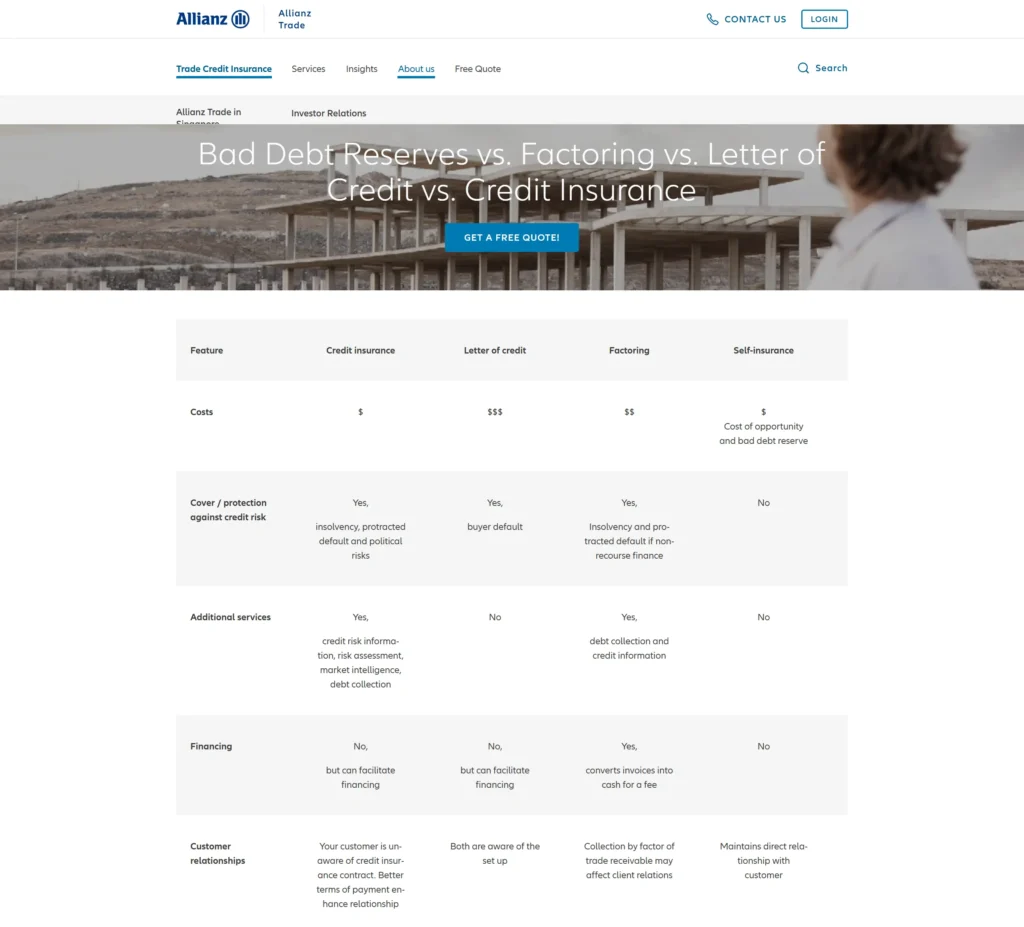
Educational comparison content helped buyers understand credit risk options before they were ready to request a quote, turning organic search from a visibility channel into a sales-support system.
THE MOMENT IT BECAME REAL
The clearest signal did not come from a ranking screenshot.
It came from a lead through a comparison page. A finance contact at a mid-sized trading business in Hong Kong arrived through an organic search about customer payment risk and ways to protect against it.
They did not land on the homepage or a paid ad. They landed on content that explained the difference between holding bad debt reserves, using factoring, relying on letters of credit, and buying credit insurance.
That mattered because the page was doing work the sales team usually has to do by hand. The buyer had a real problem. They were not looking for a blog post. They were trying to decide which financial protection option made sense for their business.
The page helped them compare the trade-offs, understand where trade credit insurance fit, and move to a quote request. By the time the form came through, the buyer already had the context sales would otherwise spend a first call building.
That was the turning point. Organic search stopped feeling like a visibility project and started behaving like a sales-support system.
For a low-awareness product, SEO earns its place when it prepares buyers to decide, not just when it brings them to the door.
RESULTS
Organic became the stronger lead channel
By month nine, organic reached a similar traffic scale to paid but did far more with it. Organic produced 17 leads a month against paid's five, roughly three times the volume, with no extra media spend.
OUTCOME
RESULT
SOURCE
Organic sessions, SG + HK
699 → 3,739 / mo
Adobe Analytics
Organic leads, SG + HK
5 → 17 / mo
Adobe Analytics + CRM
Top-10 keyword rankings
18 → 79
Rank tracking
Singapore organic leads
2 → 10 / mo
Adobe Analytics + CRM
Hong Kong organic leads
3 → 7 / mo
Adobe Analytics + CRM
Comparison page position
31 → 3
Rank tracking
Organic vs paid session-to-lead
~0.45% vs ~0.15%
Adobe Analytics + CRM
Channel contribution — Both ran at a similar session scale by month nine, so these describe contribution, not a sum. They did different jobs.
DEMAND BUILDER
Organic Search
No incremental media spend
3,739 sessions / mo (from 699)
17 leads / mo (from 5)
~0.45% session-to-lead
79 top-10 keywords (from 18)
DEMAND CAPTURE
Paid Search
[US$28,000 managed media]
~3,444 sessions / mo (9-mo avg)
~5 leads / mo (9-mo avg)
~0.15% session-to-lead
captures high intent while SEO matures
The win was not just more free traffic. It was better alignment between search intent, content, page experience, and conversion timing. One honest note: organic’s own session-to-lead rate fell from 0.72% to 0.45% as it scaled, because SEO expanded from a narrow pool into a larger demand-creation channel. It brought in more early-stage buyers and still produced far more leads overall.
WHAT'S NEXT
Turn a recovered channel into a durable asset
The next phase builds on the recovery with deeper topic coverage, sharper market pages, and tighter feedback into SEO.
- Build topic clusters around bad debt, export credit risk, insolvency, and receivables protection.
- Create market-specific conversion pages: competitive depth for Singapore, sharper paths for Hong Kong.
- Connect SEO to remarketing so research-stage visitors return with a quote or consultation CTA.
- Feed CRM lead-quality back into SEO so prioritization favors pages sales actually wants.
- Build executive reporting around channel roles: paid captures, SEO educates, CRM judges quality.
- Expand comparison pages to more decisions: letters of credit, factoring, country and sector risk.
Want organic to carry your export pipeline?
I build SEO, paid, content, and tracking as one connected system, run by one senior operator.
STAY CONNECTED
Get the next case study in your inbox
Expert marketing insights, latest industry trends, relevant case studies, and practical tips sent exclusively to subscribers.
Thank you for subscribing!
// Export B2B marketing insights · unsubscribe anytime
Share this case study
This case study is published with the client’s permission. Specific internal figures have been limited to what was cleared for release.
Results are based on Adobe Analytics, Google Search Console, rank tracking, Google Ads, and CRM lead-source records. Media spend was client-owned budget managed through the program. Lead figures refer to organic-sourced and paid-sourced leads recorded in the CRM during the nine-month period, not guaranteed closed revenue. This was a B2B sale with long buying cycles and sales-team follow-up. Paid search worked as the demand-capture channel; organic search built demand earlier in the buyer’s decision, with several leads touched by more than one channel before conversion.